
Quick answer
It can, but for most passengers it does not — and morning departures between 08:00 and 11:00, when Skjálfandi Bay is typically calmest, give you the best odds of staying comfortable. Susceptibility varies with rest, hydration, and prior boat experience, so seasickness is far from guaranteed, especially on a well-timed, sheltered outing.
Roughly one in three first-time passengers boards a boat in Skjálfandi Bay expecting to feel ill, yet most step back onto the pier at Hafnarstétt 11 without a single queasy moment. So does whale watching make you seasick? The honest answer is that it can, but seasickness is a probability rather than a certainty, and one shaped far more by conditions and personal preparation than by the activity itself. Motion sickness begins in the inner ear, where the vestibular system senses movement that the eyes cannot always confirm. On the open water of a Húsavík whale watching tour, the swell of the North Atlantic sends the brain signals it struggles to reconcile, and the result is nausea for a share of travellers. Sensitivity varies widely from person to person. Age, hydration, sleep, and prior experience with boats all play a part, and those prone to carsickness or headaches often feel the effect earliest. Seasoned sailors, by contrast, may notice almost nothing across a full outing on the bay. Context matters more than most visitors expect. The harbour sits at the mouth of a sheltered bay, and the waters closest to shore tend to move less than the ground swell further out, where baleen whales and humpbacks come to feed. Free entry to the harbour area means that arriving early costs nothing, and settling in before a departure gives the body time to find its sea legs. A clear whale watching in Húsavík guide is most useful when it separates what a traveller can influence from what the sea decides on its own. What should a reader do with all of this? Treat the question does whale watching make you seasick as a planning prompt, not a warning to stay ashore. The odds tilt heavily toward a comfortable trip when the body is rested and the timing is chosen with care, and the harbour's daily hours of 08:00–21:00 leave plenty of room to match a departure to both the forecast and one's own tolerance. Whales surface, the hull rocks gently, and the large majority of guests watch from the rail feeling entirely well.
“Treat the question of seasickness as a planning prompt, not a warning to stay ashore.”
Does Whale Watching Make You Seasick on a RIB vs. Oak Boat?
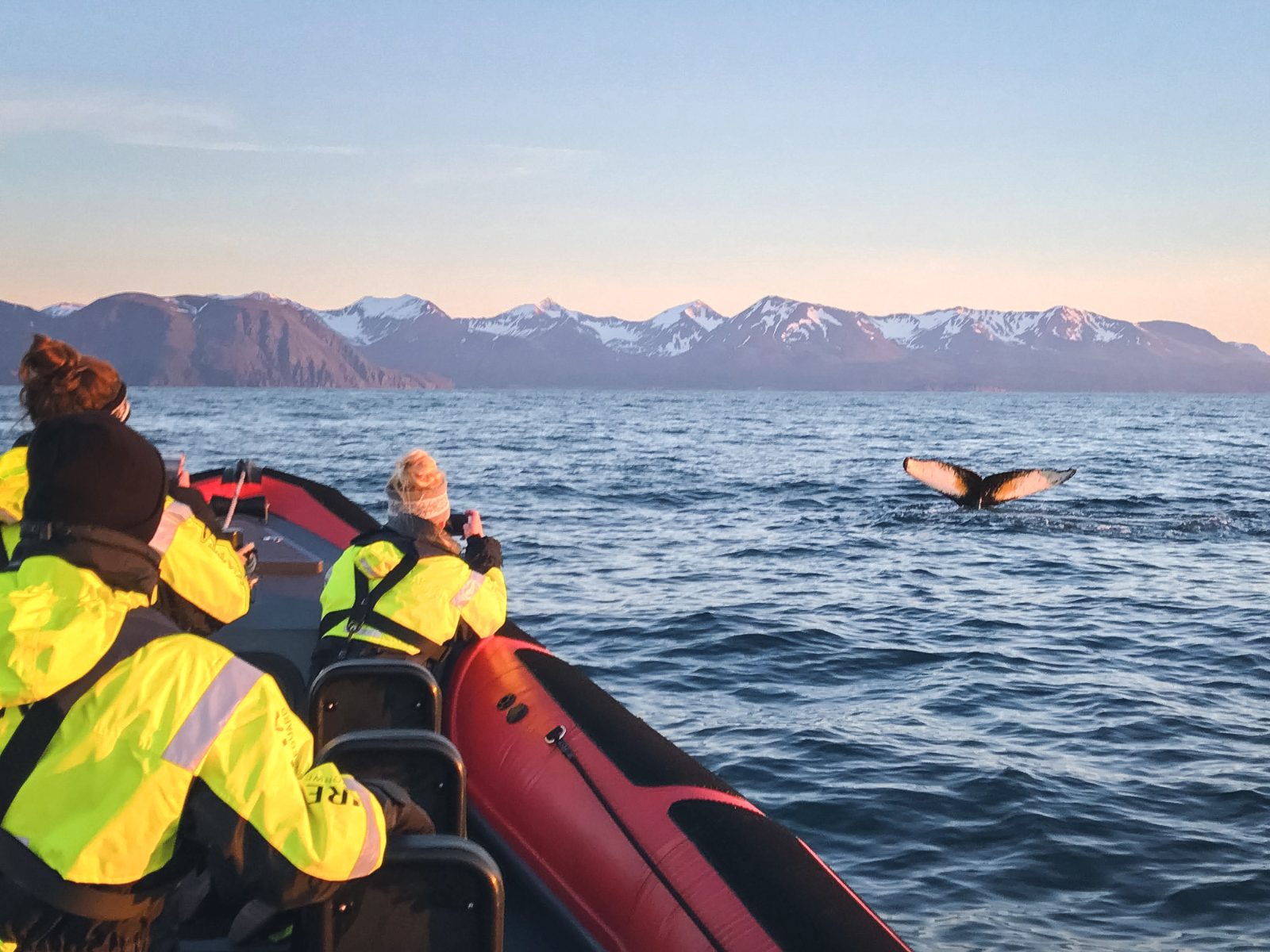
Selecting the right vessel in Húsavík directly impacts your comfort on the water. Travelers must decide between the high-speed, jarring motion of a rigid inflatable boat (RIB) or the slow, rolling sway of a traditional oak vessel.
|
Top pick RIB Speedboats Planing hulls with active astride seating |
Traditional Oak Boats Displacement hulls with traditional deck space | |
|---|---|---|
| How they move on the water | Glides and bounces over the waves on a planing hull, which reduces side-to-side rolling but increases vertical vibrations | Rides with the swells on a heavy wooden displacement hull, creating a continuous, low-frequency swaying motion |
| Cruising speed | 25 to 30 knots (46 to 55 km/h) to rapidly reach whale habitats | 7 to 9 knots (13 to 17 km/h) for a slow and steady cruise |
| Who they are best for | Passengers seeking a faster trip who prefer quick, bumpy transit over prolonged exposure to sea swells | Passengers who prefer to stand, walk around, or sit comfortably without experiencing high-speed wind and physical jarring |
| Risk of motion sickness | Lower risk of classic motion sickness as the fast forward wind and lack of rolling keep the vestibular system stable | Higher risk of triggering motion sickness due to the constant, slow-rolling rhythm of the ocean swells |
Verdict: If you are highly prone to seasickness triggered by slow rolling motions, the RIB speedboat is the recommended option to minimize your time on the swells.
Best Departure Times to Avoid Getting Seasick While Whale Watching
The most reliable daily window for calm seas in Skjálfandi Bay is between 08:00 and 11:00. Booking during these morning hours minimizes exposure to the choppier waters caused by rising afternoon winds.
Morning departures (08:00–11:00)
Moderate passenger numbers—
Winds are typically calmest during the early morning hours, which creates flatter water. This is the best timing for anyone highly prone to motion sickness.
Midday departures (12:00–15:00)
Highest daily passenger volume—
As the sun warms the land, coastal thermal winds usually increase and generate more surface waves. The motion on the bay is typically more pronounced during these hours.
June to August
Peak summer tour attendanceAverage summer temps 7°C to 13°C
Summer provides the most stable overall weather patterns of the year in North Iceland. Wind conditions are generally calmer, though sudden shifts still occur.
September to October
Low seasonal tour attendanceCool autumn temps 2°C to 10°C
Autumn brings stronger northern swells and faster-shifting weather systems. The increased wind makes the sea rougher, raising the likelihood of motion sickness.
Verdict: For the calmest seas and lowest chance of motion sickness, book a morning tour departing between 08:00 and 11:00 during July or August.
Myths and Facts: Does Whale Watching Make You Seasick?
Many misconceptions surround the causes and prevention of motion sickness on the water, often leading visitors to make counterproductive choices before their tour. Understanding the physiological reality behind these beliefs helps ensure a more comfortable whale watching experience in Húsavík.
MythFasting or keeping an empty stomach before boarding prevents seasickness.
FactTraveling with an empty stomach allows gastric acids to build up, which actually aggravates nausea. Eating a light, bland snack like crackers about an hour before departure helps stabilize the stomach.
MythDrinking large volumes of water right before a tour prevents motion sickness.
FactStaying hydrated is necessary, but gulping down large amounts of fluid increases stomach sloshing, triggering nausea. Sip small amounts of water slowly throughout the trip instead.
MythSeasickness is a psychological issue that can be overcome by willpower alone.
FactIt is a physical response caused by sensory conflict between the inner ear and the eyes. Willpower cannot stop this physiological reaction, though physical remedies can mitigate the symptoms.
MythVomiting during the tour will immediately cure your seasickness and make you feel better.
FactWhile vomiting may bring brief relief, it does not resolve the sensory conflict causing the motion sickness. Symptoms like nausea and dizziness will often continue until you return to stable ground.
Expert Tips to Prevent Seasickness During Húsavík Whale Watching
Maximize your comfort on Skjálfandi Bay with these practical, onboard techniques to stabilize your body and minimize motion sickness.
Position yourself near the stern
Seating at the back of the vessel experiences the least vertical movement, minimizing the pitch that triggers nausea.
Fix eyes on the horizon
Stare at the stable Icelandic shoreline rather than the moving water or camera screens to align your visual input with your inner ear.
Absorb motion with your knees
Stand with slightly bent knees to let your lower body absorb the boat's roll instead of sitting rigidly.
Secure thermal overalls at Hafnarstétt 11
Cold temperatures stress the nervous system and trigger nausea, so always wear the provided windproof overalls.
Avoid looking through binoculars continuously
Rest your eyes frequently when scanning Skjálfandi Bay, as magnifying the motion increases sensory conflict.
Avoid enclosed cabin spaces
Remaining on the open deck ensures a constant flow of fresh air, which helps regulate body temperature and suppress nausea.
Common Mistakes: Does Whale Watching Make You Seasick?
Seasickness on a whale watching tour is often the result of a few avoidable errors rather than the sea itself. Sidestep these and you improve your odds of a comfortable trip.
Waiting until boarding to take motion sickness medication
Most tablets need 1–2 hours to take effect. Take your medication 1–2 hours before your departure time, not as you step onto the boat.
Staring at a phone or camera screen during choppy stretches
Focusing on a fixed screen while the boat moves confuses your inner ear. Put the device away when the sea gets rough and look outward instead.
Assuming free harbor entry means the tour needs no booking
Entry to the harbor area at Hafnarstétt 11, 640 Húsavík is 0 ISK, but tour tickets are sold separately. Reserve your spot through the booking pages in advance.
Arriving with no time buffer before departure
Rushing raises stress, which can worsen nausea. Arrive well ahead of your departure so you can settle in calmly.
Skipping medication because the forecast looks calm
Sea conditions can shift once you leave the harbor. If you are prone to motion sickness, take precautions regardless of the forecast.
Not calling ahead when unsure about timing or conditions
Phone +354 464 7272 or check https://www.northsailing.is/ to confirm your departure and current details before you travel.
Your Seasickness Prevention Checklist for Húsavík Tours
Work through these steps in order, from the weeks before your trip down to the morning you sail, so motion sickness stays off the water.
-
Book your RIB tour in advance — Reserve your spot through the North Sailing booking pages at https://www.northsailing.is/ or call +354 464 7272.
-
Confirm the departure time you booked — Note your slot so you can target the 08:00–11:00 arrival window for calmer seas.
-
Buy motion sickness remedies beforehand — Pick up medication or wristbands at home rather than scrambling on the day.
-
Pack ginger chews or ginger tablets — Keep a few in a pocket for easy access before boarding.
-
Bring layered, windproof clothing — Húsavík mornings are cold and spray-heavy, so waterproof layers keep you steady.
-
Arrive at Hafnarstétt 11 by 08:00–11:00 — Reach the harbor early; entry is free at 0 ISK, and tickets are handled separately.
-
Bring photo ID and booking confirmation — Have both ready at check-in to board without delay.
Check availability
FAQ: Does whale watching make you seasick?
Everything you need to know about does whale watching make you seasick