
Quick answer
Whale watching in Húsavík is governed by a voluntary industry code of conduct rather than statute, so boats keep their distance and throttle back near the animals. Access to the harbour at Hafnarstétt is free, open around the clock, with 08:00–17:00 the advised arrival window for the best light and sea state before departures.
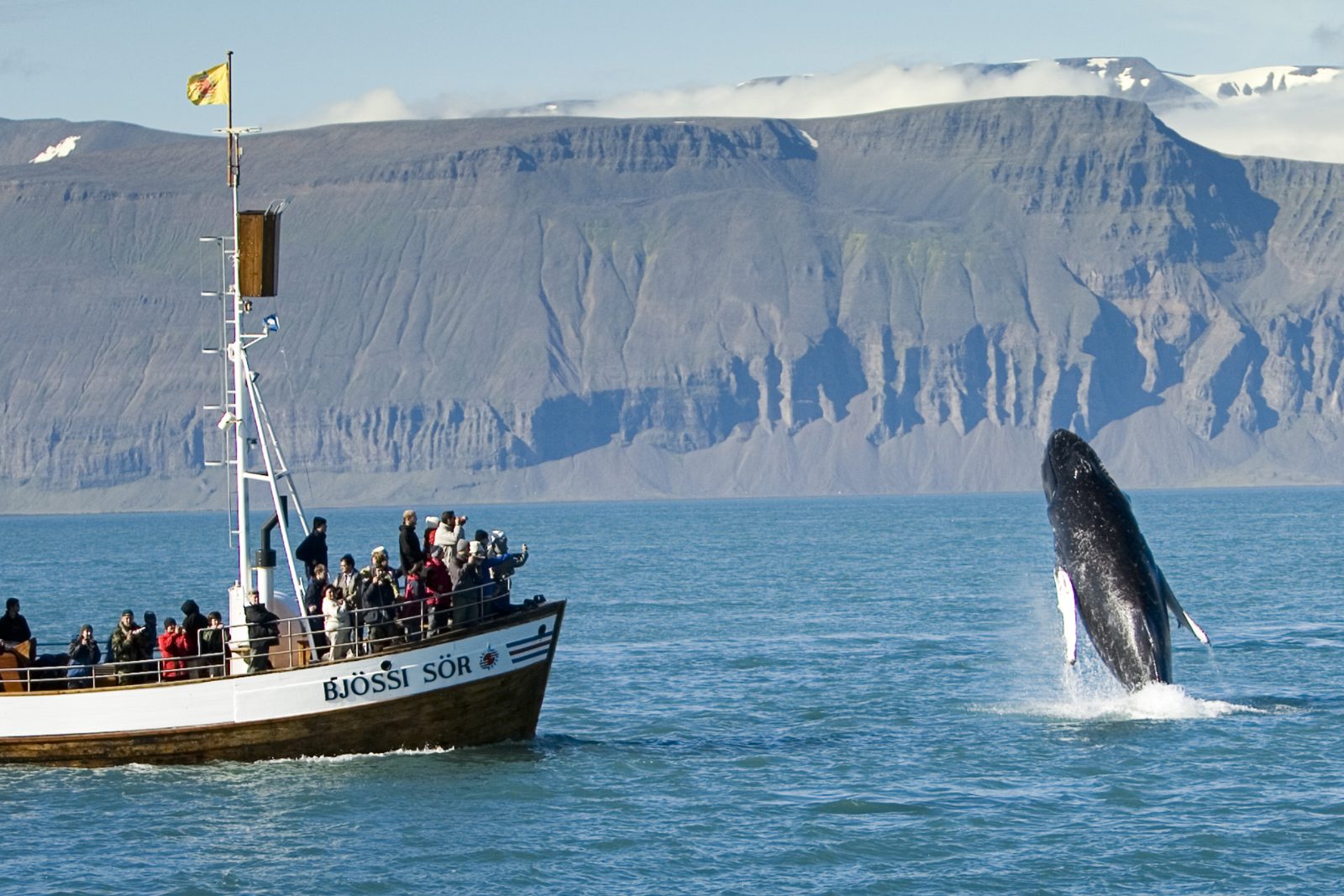
Húsavík ran Iceland's first organised whale watching tour in 1995, and the town has shaped the country's whale watching rules ever since. What began as a handful of restored oak boats crossing Skjálfandi Bay has grown into a working template for responsible whale watching across the North Atlantic. The regulations that govern each trip were written on this water, tested against real encounters with humpback whales and minke whales, and refined season after season. Most visitors assume these codes are national law. They are not. Iceland's whale watching operators follow a voluntary code of conduct, drafted by the industry itself and aligned with guidance from the International Whaling Commission. The code covers how vessels behave around marine mammals, how captains read the animals, and how encounters end without disturbance. Because Skjálfandi Bay is a nursery and feeding ground, the standards here run stricter than the printed minimum. Operators treat the code as a licence to keep operating, not a suggestion. The practical upside for a visitor is simple. Ethical whale watching does not cost more, and the harbour itself asks nothing of you. Access to the working quay at Hafnarstétt is free, with no entrance fee and no gate. The pier stays open around the clock, though the recommended arrival window sits between 08:00 and 17:00, when daylight and sea conditions best support departures. Reading the whale watching rules guide before you arrive means you already understand what a good crew will and will not do once the engines idle down. This page frames the regulatory picture rather than the itinerary. It explains where the standards came from, who enforces them, and why hvalaskoðun in this bay carries a reputation the rest of Iceland measures against. The finer mechanics — how close a boat may drift, which season fills the bay, how to reach the harbour, what to pack — live in their own sections of this guide. Here the goal is context: to show that the difference between a tour that respects the animals and one that chases them is written into a code most passengers never see. Choose an operator that publishes its conduct standards, and the rest of the visit tends to follow the same care.
“The difference between a tour that respects the animals and one that chases them is written into a code most passengers never see.”
Key Dos and Don'ts of the Whale Watching Rules
Under the IceWhale Code of Conduct, both crew and passengers share responsibility for calm, respectful encounters that keep whales undisturbed. How you behave onboard directly shapes each animal's comfort and safety.
Do
- Follow crew instructions on positioning and movement during every encounter
- Let whales choose to approach the vessel on their terms
- Keep your voice low so animals stay relaxed
- Stay seated and steady when the engine idles near wildlife
- Report any distressed or entangled animal to the crew
- Give other boats space to share the sighting
Don't
- Don't lean over railings or reach toward passing whales
- Don't feed, touch, or attempt to swim with wildlife
- Don't shout, whistle, or bang on the hull
- Don't crowd one side and destabilise the boat
- Don't discard litter or plastic into the water
- Don't pressure the crew to chase or corner animals
Step-by-Step Approach Zones Defined by Whale Watching Rules
Approaching a whale is a graduated sequence that shifts vessel behaviour by distance band, from first sighting past 3000 metres down to the closest permitted 50-metre threshold. Skippers work through these zones over several minutes, easing speed and heading as the gap narrows.
Scan from the Search Zone
Beyond 3000 metres the vessel travels at normal cruising speed while the crew scans for blows and surface movement. The common error is charging straight toward the first spout instead of plotting a slow, indirect line.
Slow on entry past 1000 metres
Inside roughly 1000 metres the skipper drops to a steady no-wake speed and holds a consistent heading. People often keep full throttle too long, which pushes a bow wave and pressure wave ahead of the boat.
Enter the Approach Zone under 300 metres
Below 300 metres speed falls to dead-slow and the vessel angles alongside the animal's course rather than head-on. The frequent mistake is cutting across the whale's path, which blocks its travel line.
Hold the 50-metre Caution Zone
Inside 50 metres the engine goes to neutral or idle and the boat drifts, letting the whale set the distance. Crews sometimes edge closer to chase a better view, which is exactly what the caution band forbids.
Never crowd or corner
Only one vessel closes at a time, and none should box the animal against another boat or the shore. The error is several craft converging from different angles.
Withdraw slowly and resume speed
When leaving, reverse the sequence: idle out to 300 metres, then build speed gradually past 1000 metres. Accelerating early near the animal undoes the careful approach.
Interesting Ecological Facts and Whale Watching Rules
Understanding the biological reasons behind whale watching rules helps protect marine mammals. The code of conduct developed by IceWhale at https://icewhale.is ensures ethical guidelines are followed in Skjálfandi Bay.
172 decibels of engine noise
A 2020 study showed that at this noise level, humpback whale mothers reduced their resting time by 30%. Their breathing rates doubled and swimming speeds increased, consuming vital energy reserves.
81 percent less nursing time
Research on pilot whales demonstrated that loud petrol engine noise reduced calf nursing by this margin. In contrast, quieter electric engines caused no significant reduction in maternal care.
11 whale species in Skjálfandi Bay
Departing from Hafnarstétt, 640 Húsavík, Iceland, boats enter a bay that serves as a critical summer feeding ground. Ethical codes protect these species, including blue and humpback whales, from vessel disruptions.
20 to 30 minutes maximum
The IceWhale code of conduct limits vessel visits with a single whale to this duration. This limit prevents cumulative stress and ensures animals can rest between encounters.
150 decibels threshold
Scientists recommend keeping ship noise below this level to prevent behavioral disturbances. Exceeding this limit can mask the low-frequency calls baleen whales use to communicate.
125 kilohertz vessel noise
At this frequency, propeller cavitation noise can mask the echolocation clicks of toothed whales. This interference degrades their hunting ability, requiring longer search times for prey.
Best Times to Go Under Local Whale Watching Regulations
The optimal time for whale watching under IceWhale conservation guidelines is between June and August when calm seas allow boats to easily maintain safe distances. During these summer months, scheduling departures within the daily window of 08:00 to 17:00 ensures peak daylight, making it easier for vessels to spot blow patterns and adhere to approach codes.
June to August
High volume of summer touristsCool temperatures averaging 7°C to 11°C
This period offers calm waters that help crews monitor distance thresholds defined in the local code. Stable sea conditions minimize sudden maneuvers, ensuring a low-stress environment.
September to October
Fewer crowds and shorter queuesBrisk climate averaging 2°C to 7°C
Shorter daylight hours restrict safe tour windows, but fewer vessels make managing zone regulations simpler. Adherence to speed limits remains critical as weather becomes more unpredictable.
April to May
Moderate visitor numbersCool weather averaging 1°C to 5°C
Spring marks the arrival of migratory whales, requiring strict adherence to encounter duration limits. Reduced traffic makes it easier for boats to respect whale-free buffer zones.
Weekday mornings
Lowest daily visitor density—
Booking morning departures between 08:00 and 11:00 provides calmer waters for tracking blow intervals. With fewer vessels in the bay, captains coordinate easily to avoid crowding.
Verdict: The best overall slot to observe whales is Tuesday to Thursday between 08:00 and 11:00 from June to August, when calm conditions make adhering to vessel approach regulations easiest.
Getting to Hafnarstétt Harbor for Ethical Whale Watching Tours
Hafnarstétt Harbor is situated right at the waterfront of Húsavík town center, serving as the primary boarding point for local whale watching departures. Visitors can easily access this northern coastal destination by driving along Route 85 or utilizing the regional public transport network from Akureyri.
Route 85 north to Hafnarstétt, Húsavík
Strætó Route 79 from Akureyri - Hof to Húsavík
Garðarsbraut to Hafnarstétt Harbor
Passenger Checklist for Respectful Whale Watching Trips
Work through these steps in order, from booking weeks ahead to final checks on the day, so boarding runs smoothly.
-
Book your tour slot online early — Summer RIB departures fill quickly, so reserve well ahead through the operator's booking page at icewhale.is.
-
Check age and height limits — RIB boats set minimum age and height rules for safety, so confirm your group qualifies before booking.
-
Flag pregnancy or back conditions — RIB rides are bumpy; pregnant passengers and those with back or heart issues should choose a calmer vessel or consult the operator.
-
Pack warm windproof layers — Open-water wind stays cold even in summer, so bring a hat, gloves, and a waterproof outer layer.
-
Wear flat non-slip footwear — Decks get wet and unsteady, so closed, grippy shoes keep you safe when boarding and moving.
-
Take seasickness precautions — If you are prone to motion sickness, take medication before departure rather than once at sea.
-
Arrive within the 08:00–17:00 window — Aim for the 08:00–17:00 arrival window at Hafnarstétt for the best daylight and departure conditions.
-
Bring photo ID and confirmation — Staff may check identification and your booking reference at check-in, so keep both accessible.
Check availability
FAQ: Ethical Whale Watching Rules in Húsavík
Everything you need to know about whale watching rules